
PORTFOLIO
FoundHer Edge Community
Mentorship & Coaching Membership

Context
Meet Peter Svenneby. Peter is a coach, consultant, and trainer with over 25 years of experience in leadership and sales. He had spent decades designing programs for corporate contexts, but for years, he had been cultivating a different vision: creating a supportive community for female founders.
In fact, he had years of recorded content (online workshops going back to 2006) but this wasn’t the way he conceived this work.
He was looking for a way to help female founders “embody” the knowledge, not just be knowledge receivers.
Time passed and he hadn’t acted on this idea.
Every time he would come back to it, his mind would turn on him:
Where do I even start?
Is there anyone who can support me while I’m still figuring it out and building alongside a busy client schedule?
Peter wasn’t just looking for a place to host some videos; he was looking for a home for his community. He discovered Sutra, an ecosystem built for reflective, social learning. It perfectly matched the vision he had: a platform driven by human connection and relational learning. But he quickly realized that having the right technology was only half the battle. He had the vision and the content, and now he needed a partner to help him architect the experience so he could build it alongside his busy schedule.
That is where I came in.
The Process
Our goal was to:
– cut through the noise of the immense library of content,
– focus on the transformational and relational parts that would make this learning really stick.
To do this, we had to move away from a “content-first” approach towards the “learner profile”. The structure was designed meeting the needs of the female founder for whom the whole community was being created. The content needed to support the relational core of the community, not the other way around.
How it works in practice
To lay the foundation for our work I always rely on the clarity of the ADDIE model (systematic framework used in instructional design for effective learning).
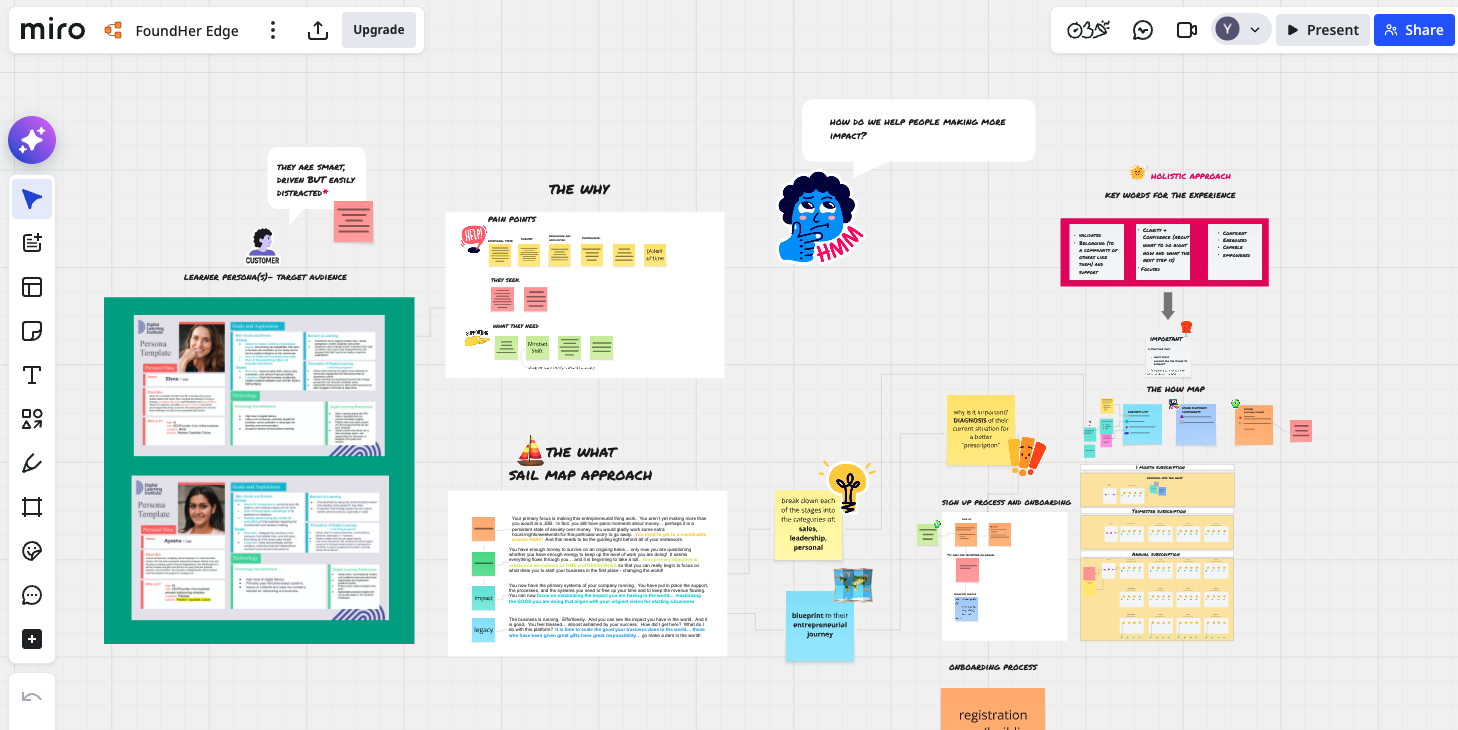
We started by brainstorming heavily on:
– Who this community was for,
– Why they needed it (what problem it solved)
From this, we moved into organizing the What (content that would have been delivered) and the How (the community experience in tiself).
How it Looks like
One of the various digital tools that can be helpful to give visual representation in this kind of cases is Miro board.
And it can look like this:
What I love about this process
It’s a very structured and visual process.
If you have lots of different ideas and nuances in your head, it’s very difficult to organize them.
When you brainstorm the ideas with proven systemic methods of instructional design, you get to document each component and see a visual representation that help you:
-gain clarity on the program/community that you want to create,
-generate new insights.
Outcome
- This is a living community since 2024 offering an annual membership (visit foundheredge.com to have a look!);
- female founders from different parts are part of it;
- live interactions proved to be the core component, all the rest is an add-on.
Key Takeaways
“If you're a coach looking to create a truly engaging group experience (not just a container but a living community) , Yana is an exceptional partner ”

Peter Svenneby
Coach & Founder of FoundHer Edge